
The unrushed Great Ocean Road: seven days from Geelong


Most people do this in two days. They shouldn’t. Here’s the version with the Twelve Apostles to yourself.
The Great Ocean Road is the most famous drive in Australia, and most people ruin it by doing it in two days. They arrive at the Twelve Apostles at 11am with four tour buses, take the photo over someone’s shoulder, and drive on. That’s not the trip. That’s the trailer for the trip.
Seven slow days from the LGM Geelong branch is the real thing. You walk Bells Beach at dawn, have coffee at three different Apollo Bay cafés on three different mornings, and stand at the Twelve Apostles at sunrise with almost nobody else there. The longest single drive is 1 hour 45 minutes. One day has no driving at all.
The road is winding, so the drive times run longer than the distances suggest — which is the whole reason to give it a week. Fuel coverage is total; every coastal town has a station. Nothing here is remote. It’s just better slow.
Most people arrive at the Twelve Apostles at 11am with four tour buses. Do it in seven days and you get the sunrise to yourself.
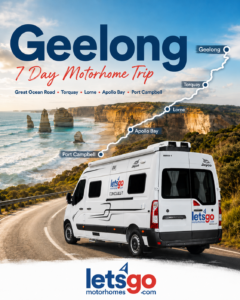
The trip at a glance
Here’s what the week looks like before we go day by day.
-
Day 1 — Geelong to Torquay. 25 km, 30 min.
-
Day 2 — Torquay to Lorne. 45 km, 1 hr.
-
Day 3 — Lorne to Apollo Bay. 45 km, 1 hr 15 min.
-
Day 4 — Apollo Bay slow day. Optional Cape Otway.
-
Day 5 — Apollo Bay to Port Campbell. 100 km, 1 hr 45 min.
-
Day 6 — Twelve Apostles day. Local only.
-
Day 7 — Port Campbell back to Geelong. Split via Colac.
Total drive distance over the week: around 430 km. The longest single leg is 1 hour 45 minutes. Day 7’s longer return is split into two roughly 75-minute legs with a Colac lunch break. One pure no-drive day.
Day 1 — Geelong to Torquay
DRIVE · Geelong → Torquay · 25 km · 30 minutes
Collect the motorhome from the LGM Geelong branch and drive the short 30 minutes to Torquay, the official start of the Great Ocean Road and the birthplace of Australian surf culture.
Stay at BIG4 Beacon Resort. Walk out to the Bells Beach lookout in the afternoon — the most famous surf break in the country — and visit the Australian National Surfing Museum. Dinner in town. The trip starts gently.
Day 2 — Torquay to Lorne
DRIVE · Torquay → Lorne · 45 km · 1 hour
An hour down the coast, and this is where the Great Ocean Road becomes the Great Ocean Road — the cliffs, the surf, the road carved into the headland. Stop at the Split Point Lighthouse at Aireys Inlet on the way.
Arrive Lorne by lunch. Stay at the Lorne Foreshore Caravan Park, walk the beach, and head up to Teddy’s Lookout for sunset — the view back along the coast road is one of the best on the whole drive.
Day 3 — Lorne to Apollo Bay
DRIVE · Lorne → Apollo Bay · 45 km · 1 hour 15 minutes
Only 45 km but allow 75 minutes — this is the most spectacular and most winding stretch of the entire road, and you’ll want to stop constantly. Erskine Falls is a short detour inland. Kennett River, about halfway, has wild koalas in the roadside trees almost guaranteed.
Arrive Apollo Bay mid-afternoon. Stay at BIG4 Apollo Bay Pisces. It’s a working fishing town with a good beach and better seafood — a place worth more than the single night most itineraries give it.
Day 4 — Apollo Bay slow day
DRIVE · Stay put — optional 25 km return to Cape Otway
The no-driving day, and the one most Great Ocean Road trips never include. Option one: drive out to the Cape Otway Lightstation, 25 km return, the oldest surviving lighthouse on mainland Australia, through forest thick with koalas. Option two: do nothing at all — the Apollo Bay beach, the harbour, a long brunch, a slow afternoon.
Either way, this is the day the trip earns. Nobody who rushes the Great Ocean Road in two days gets a morning like this.
Day 5 — Apollo Bay to Port Campbell
DRIVE · Apollo Bay → Port Campbell · 100 km · 1 hour 45 minutes
The road turns inland through the Otway forest before returning to the coast for the famous limestone stretch. If you want the rainforest, the Otway Fly Treetop Walk is a worthwhile detour on the inland section.
Arrive Port Campbell early afternoon. Stay at Port Campbell Holiday Park or the Recreation Reserve. Port Campbell is a tiny town that exists because of what’s just down the road — which you’ll see properly tomorrow.
Day 6 — Twelve Apostles day
DRIVE · Local — under 30 km return to the lookouts
This is the day the whole trip is built around, and the secret is the time of day. Be at the Twelve Apostles for sunrise. The tour buses don’t arrive until mid-morning — at dawn, in winter especially, you can have one of the most famous views in the world very nearly to yourself.
Loch Ard Gorge mid-morning, with the shipwreck history that’s as dramatic as the geology. London Bridge and the Grotto in the afternoon. Then go back to the Apostles for sunset — different light, different crowd, same astonishing thing. Seeing it twice in a day, at the two best times, is what seven days buys you.
Be at the Twelve Apostles for sunrise. The buses don’t arrive until mid-morning — in winter you can have one of the world’s most famous views nearly to yourself.
Day 7 — Port Campbell back to Geelong
DRIVE · Port Campbell → Geelong, split via Colac · 185 km total · Two legs with a Colac lunch break
The return runs inland — faster than the coast road and a different kind of country. Split it: Port Campbell to Colac first, around 90 km and 1 hour 15 minutes, a lunch stop, then Colac to the LGM Geelong branch, around 95 km and 1 hour 20 minutes.
Back at the branch by late afternoon. You did the Great Ocean Road the way the photographs make it look — empty, slow, and yours — instead of the way most people actually experience it.
Practical notes for the trip
Fuel and route
Fuel coverage is excellent — every coastal town on the route has a service station: Torquay, Lorne, Apollo Bay, Port Campbell. The inland return via Colac is equally well-served. There is no point on this itinerary where fuel is a consideration.
Our fuel info page links the federal government’s fuel availability site for the broader picture. For the Great Ocean Road, fuel is simply never a concern.
For the latest fuel availability tools and route-planning advice, visit our fuel information page before you travel.
Vehicle suitability
All LGM vehicle sizes are suitable, but the Great Ocean Road is winding and the drive times run well beyond what the distances suggest — drive to the conditions, not the clock. A sub-7m vehicle is easier in the tighter Lorne and Apollo Bay parking. Every caravan park on the route has powered sites.
Best season
Year-round. Summer is peak and the road is busiest. Autumn, March to May, gives the best light for photography. Winter is quiet, dramatic, and atmospheric — and crucially, it’s when you get the Twelve Apostles at sunrise to yourself.
What to book in advance
The Apollo Bay and Port Campbell caravan parks book out over summer and school holidays — reserve ahead for those periods. Winter and shoulder-season midweek travel can generally be booked closer to the date.
The Aussie Winter Wander Sale — 25% off May to July
The unrushed Great Ocean Road is the version worth doing, and right now it’s 25% off. Every May, June and July booking from the LGM Geelong branch is discounted as part of the Aussie Winter Wander Sale.
The sale runs 15 May to 25 May. After that, full price returns. Winter is the season that gives you the empty sunrise at the Apostles — and the next ten days are the cheapest way to book it.