
Seven days from Cairns by motorhome: the Reef, the Daintree, and the Tablelands done slowly


The unrushed version of the trip everyone tries to do in four days. Two World Heritage areas, one waterfall loop, and not a single drive over two hours.
Cairns is the only place in the world where two World Heritage areas meet. The Great Barrier Reef sits offshore. The Daintree Rainforest runs to the coast just north of town. Most people who fly in for a motorhome trip try to do both in three or four days, and most people who do that finish their trip feeling like they ran a marathon they didn’t sign up for.
Seven slow days is the answer. With a motorhome from the LGM Cairns branch, you can dive the reef on Day 2, sleep under the rainforest canopy at Cape Tribulation on Day 4, and finish with a waterfall loop through the Atherton Tablelands without ever putting more than two hours behind the wheel on any single day. The longest drive on the whole trip is broken with a lunch stop. Most days you’ll be off the road by lunchtime.
This is the unrushed Cairns itinerary. It’s built around the dry season window, May to October, it stays on well-fuelled corridors the whole way, and it leaves real space for the things you’ll remember — sunrises on the beach, slow afternoons in plunge pools, the second dive when the first one wasn’t enough.
Seven days. Two World Heritage areas. The longest drive at the wheel is two hours, with a lunch break in the middle.
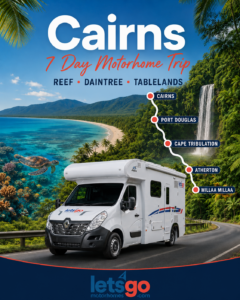
The trip at a glance
Here’s what the week looks like before we go day by day.
-
Day 1 — Cairns arrival. Pick-up, settle in, walk the Esplanade Lagoon.
-
Day 2 — Reef day. A full day at the outer Great Barrier Reef from Marlin Marina. No motorhome driving.
-
Day 3 — Cairns to Port Douglas via the Captain Cook Highway. 65 km, around 1 hour.
-
Day 4 — Port Douglas to Cape Tribulation, crossing the Daintree River by ferry. 100 km, around 1 hr 45 min.
-
Day 5 — Cape Tribulation slow day. Local only.
-
Day 6 — Cape Tribulation to the Atherton Tablelands. 165 km, broken with a Mossman lunch stop.
-
Day 7 — Tablelands waterfall loop and return to Cairns. 100 km, around 1 hr 45 min with stops.
Total drive distance over the week: around 430 km. Two days with no motorhome driving at all. The longest single leg is two hours, broken with a proper lunch stop. This is what easy fuel, short legs actually looks like in practice.
Day 1 — Arrival in Cairns
DRIVE · Local — pickup and short drive to caravan park
Pick up your motorhome from the LGM Cairns branch in the morning. The team will walk you through the vehicle — controls, water, power, where everything lives — so the first time you brew a coffee on the gas it isn’t an event. You’ll be on the road within the hour.
Today is the easy day. Your job is to land, settle in, and get the rhythm. Drive to your overnight base — Cairns Coconut Holiday Resort is the most established option, with shaded sites, two pools, and the kind of grass you can actually walk on barefoot. BIG4 Cairns Crystal Cascades is a quieter alternative tucked closer to the rainforest fringe.
In the afternoon, head into the city. The Cairns Esplanade Lagoon is the public swimming pool the postcards don’t quite show you — saltwater, with proper beach sand around the edges and views straight out to the Coral Sea. Pack a towel and a book. The Esplanade boardwalk runs for a few kilometres if you’d rather walk it off.
For dinner, the Cairns night market on the Esplanade gives you a dozen options without the commitment of a restaurant booking. Or sit down at one of the foreshore spots and watch the fruit bats come in over the mangroves — sunset in the tropics is genuinely something.
Day 2 — A day at the Great Barrier Reef
DRIVE · No motorhome driving — boat from Marlin Marina
This is the day. The Great Barrier Reef is the single most globally recognised travel image in Australia, and you don’t get to claim a Cairns trip without it.
Several operators run day boats out of Marlin Marina to the outer reef. Quicksilver, Reef Magic, Passions of Paradise, and Sunlover all run reliable full-day trips that include snorkel gear, lunch, and time at two different reef sites. If you want to dive, all of them offer intro dives for non-certified divers with a guide, and certified-diver options if you’ve got your card.
A few practical notes that the brochures bury. Stinger season runs October to May, so dry-season trips, May to October, are the comfortable months — full wetsuits are still common for warmth, but you won’t need a stinger suit the way you would in November. The outer reef is around 90 minutes by boat from Cairns, so you’re committing the day to it. Most boats leave around 8am and are back at the marina by 4.30pm. Park the motorhome at the marina car park for the day — there’s plenty of space and it’s secure.
Several operators run day boats out of Marlin Marina. Most leave around 8am and are back by 4.30pm. Park the motorhome at the marina and forget about it for the day.
Back in Cairns by late afternoon. Tonight, you’re tired in the best possible way. Pizza and a beer at your caravan park is a legitimate option. Save the strength for tomorrow.
Day 3 — Cairns to Port Douglas along the Captain Cook Highway
DRIVE · Cairns → Port Douglas via the Captain Cook Highway · 65 km · 1 hour
The Captain Cook Highway between Cairns and Port Douglas is one of Australia’s most scenic coastal drives, full stop. You’re on the coast the whole way, with the rainforest rising on one side and the Coral Sea on the other. Take your time.
Stop at Palm Cove on the way — it’s a 10-minute detour off the highway, and the beachfront cafés make for a good morning coffee with the water in view. Continue north through Rex Lookout, where the road climbs briefly and the view opens up to one of the most photographed stretches of Queensland coastline.
Arrive in Port Douglas by late morning. Settle in at Tropic Breeze Caravan Park or Glengarry Tourist Park — both within walking distance of the main strip. Lunch on Macrossan Street, then spend the afternoon at Four Mile Beach. The name does the work — it really is four miles of soft sand, and on a weekday it can feel like you’ve got it to yourself.
Climb Flagstaff Hill before sunset. It’s a short walk to the lookout at the top, and the view back over the Coral Sea while the sun drops behind the rainforest is the kind of thing that justifies the trip on its own. Dinner in Port Douglas — Hemingway’s Brewery and Salsa Bar & Grill are both reliable, and there’s enough else along Macrossan Street that you won’t run out of options.
Day 4 — Port Douglas to Cape Tribulation
DRIVE · Port Douglas → Cape Tribulation via Daintree ferry · 100 km · 1 hour 45 minutes including ferry
Today you cross from one World Heritage area to the other. Stop at Mossman Gorge on the way out of Port Douglas — it’s a 30-minute detour but it earns it. There’s a shuttle bus from the visitor centre that drops you at the swimming holes; the water is cold even in dry season but it’s clear enough to count the pebbles, and the rainforest closes in around you in the way that pictures never quite capture.
From Mossman the road runs north to the Daintree River. The ferry is the only way across, and it takes motorhomes without fuss — there’s a small fee, and the crossing itself is about five minutes. The road on the other side is sealed all the way to Cape Tribulation, but it’s slower than what you’re used to. Tight corners, occasional cassowary signs that are not just decoration.
Take the slow road. Stop at Alexandra Range Lookout for the first proper view of Cape Tribulation from above. Continue through to Cow Bay and Thornton Beach — both worth a quick look, both with places to pull off for a coffee or a swim.
Arrive at Cape Tribulation in the mid-afternoon. Stay at Cape Trib Beach House — the campground sits right behind Myall Beach, and the access track from your van to the sand is about 100 metres. PK’s Jungle Village is the other option — more amenities, slightly further from the beach. Either way, you’re sleeping somewhere you’ll want to remember.
Day 5 — A slow day at Cape Tribulation
DRIVE · Local — under 20 km total
This is the day Cairns motorhome trips are built around. Cape Tribulation is the only place in the world where two World Heritage areas physically meet — the Daintree Rainforest runs right to the beach, and 30 kilometres offshore the Great Barrier Reef begins. You can see both from the same patch of sand.
In the morning, head to the Daintree Discovery Centre. It’s about 25 minutes south of Cape Trib, so technically you’re driving today, but it’s a local hop. The aerial walkway puts you at canopy height — you’re walking through the tops of trees that have been growing since before the dinosaurs. The audio tour is genuinely good, not the usual phoned-in version. Allow two hours.
Lunch back at Cape Tribulation village. There’s a small handful of cafés — the Cape Trib Beach House restaurant is the most reliable, with a deck that looks out over the trees. After lunch, walk Cape Tribulation beach itself. The walking track from the car park out to the cape takes about 40 minutes return and ends at the boardwalk lookout where the cape juts out into the Coral Sea.
Cape Tribulation is the only place in the world where two World Heritage areas physically meet. You can see both from the same patch of sand.
Late afternoon, head back to Myall Beach for a swim. The sand is golden and the water at low tide is calm enough for kids. Stinger season warnings apply — pay attention to the signage at the access point and check with your campground host on the day. Most dry-season days are safe for swimming with normal precautions.
Sunset at the beach. The reef is out there somewhere, the rainforest is at your back. This is the photograph people put on their walls when they get home.
Day 6 — Cape Tribulation to the Atherton Tablelands
DRIVE · Cape Tribulation → Atherton via Daintree ferry and Mossman · 165 km · 2 hours total — broken with a Mossman lunch stop
Today is the longest drive of the week, and it’s still well inside the two-hour brief — with a proper break in the middle. You’ll head south back across the Daintree ferry, stop at Mossman for lunch, then climb up the range to the Atherton Tablelands.
Leave Cape Trib by mid-morning. The drive south to the ferry is the same scenic stretch you came in on, in reverse — it’s worth a second look. The ferry queues are shorter heading south than they were heading north. Allow 15–20 minutes for the wait and crossing combined.
Lunch in Mossman. The Mojo Brunch Bar is the local favourite for a proper sit-down, but if you’re after something quicker, the bakery on the main street is reliable and quick. From Mossman you’ve done about 90 minutes of driving so far — pause, fuel up if you need to, and treat the second leg as a separate drive.
From Mossman, head south on the Captain Cook Highway, then turn inland at the Kennedy Highway. The drive up to the Tablelands climbs about 750 metres over the first half-hour — the temperature drops noticeably as you go, which is one of the great pleasures of the trip. By the time you reach Atherton, you’re in highland country: dairy farms, crater lakes, volcanic soil red enough to stain your boots.
Stay tonight at Lake Tinaroo Holiday Park or Atherton Halloran’s Leisure Park. Lake Tinaroo is the more scenic option — sites overlook the dam, and there’s good fishing if that’s your thing. Atherton itself is a working country town with everything you need.
Drive 10 minutes from Atherton to Lake Eacham for sunset. The crater lakes — Eacham and nearby Barrine — are extinct volcanoes filled with cold, clear water. The walk around Lake Eacham takes about 90 minutes and is largely flat. Watch for platypus at dusk if you’re patient and quiet.
Day 7 — The waterfall loop and back to Cairns
DRIVE · Atherton → Cairns via Millaa Millaa and Yungaburra · 100 km · 1 hour 45 minutes with stops
The last day is the postcard day. The Atherton Tablelands has more accessible waterfalls per square kilometre than anywhere else in Australia, and the waterfall circuit out of Millaa Millaa is the easiest way to see the best of them.
Start with Millaa Millaa Falls. It’s about 30 minutes south of Atherton, and it’s the single most photographed waterfall in Australia for a reason — a perfectly symmetrical drop into a deep plunge pool, framed by tree ferns. You’ll have seen this image before; in person, it earns the hype. Swimming is allowed and the water is cold enough to wake you up properly.
From Millaa Millaa, the waterfall circuit takes in Zillie Falls and Ellinjaa Falls — both within 10 minutes’ drive of each other. Allow two hours for the three together, including a swim at Millaa Millaa.
Drive back north via Yungaburra — a heritage village with sandstone buildings, a Saturday market if your timing aligns, and a few decent lunch options. The Curtain Fig Tree is a five-minute drive from Yungaburra and worth the stop: a 500-year-old strangler fig with aerial roots that drop 15 metres to the ground like a curtain. The kind of tree you find yourself standing under for longer than you meant to.
From Yungaburra, the drive back to Cairns runs down the Gillies Range road — a series of hairpin bends that drop you back into the tropics in about 40 minutes. Take it slow, especially in a motorhome. The views on the way down are good but the road wants your attention.
Back at LGM Cairns by mid-afternoon. Return the motorhome, and book your flight home knowing you actually did the Cairns trip properly — not the rushed three-day version, the slow version. The one people remember.
Practical notes for the trip
Fuel and route
This itinerary stays on well-fuelled corridors the entire way. The Captain Cook Highway between Cairns and Port Douglas has service stations every 20–30 kilometres. North of the Daintree River, fuel is more limited — top up at Mossman before crossing the ferry. The Atherton Tablelands is well-served, with stations in Atherton, Yungaburra, and Malanda.
For the full fuel-availability picture across the country, the federal government’s fuel availability site is the most up-to-date resource. We’ve linked it on our fuel info page along with our own notes on the major corridors. The short version: nothing on this itinerary is remote, and you won’t be planning around fuel scarcity.
For the latest fuel availability tools and route-planning advice, visit our fuel information page before you travel.
Vehicle suitability
All LGM vehicle sizes are suitable for this itinerary. The Daintree ferry takes motorhomes without issue. The roads at Cape Tribulation are sealed but slower than the highway — drive accordingly. The Gillies Range road on Day 7 is winding but well-graded; just take it slow on the descents.
Best season
Dry season, May to October, is the obvious window for this trip — clear weather, fewer reef-cancellation days, no stinger suits required for ocean swimming. Wet season, November to April, is doable but the reef is weather-dependent and humidity is high. If you’re flexible, June to August is the sweet spot — cooler nights in the Tablelands, comfortable days on the coast.
What to book in advance
Reef day boats, Day 2, should be booked at least a week out in dry season — the best operators fill quickly. Caravan parks at Cape Tribulation are limited and should be booked 4–6 weeks ahead for the peak July–August window. Everywhere else in the itinerary can be booked closer to the date.
The Open Road Sale — 25% off May to July
This itinerary is the easiest version of the Cairns trip there is — but it still has to be booked. Right now, every May, June, and July booking from the LGM Cairns branch is 25% off as part of the Open Road Sale. Same vehicles, same trip, less money in the bank when you get home.
The sale runs from 15 May to 25 May, with an optional extension to 1 June. After that, it’s gone. If you’ve been deferring this trip for a year or two — and most people have — this is the window.